



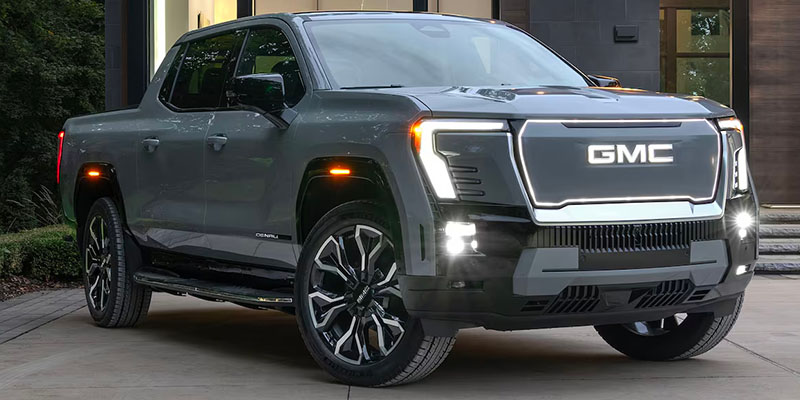
The electric pickup has arrived in earnest, and the 2026 GMC Sierra EV and Ford F-150 Lightning® represent two distinct interpretations of what a battery-powered truck should be. One evolves the familiar pickup formula into electricity; the other reimagines the pickup around electric architecture from the outset. For Idaho Falls drivers balancing work, distance, and recreation, that distinction matters more than spec sheets alone suggest.
Sierra EV vs. Ford F-150 Lightning
Power and Chassis: Architecture vs. Adaptation
Sierra EV’s Max Power output—up to 760 hp and 785 lbs. ft. of torque—delivers acceleration and towing authority that feel improbably smooth for a full-size truck. Crucially, it rides on GM’s dedicated EV truck platform with 4-Wheel Steer and CrabWalk™, giving it maneuverability the Lightning® simply cannot replicate. Tight trailers, narrow approaches, or off-axis positioning become noticeably easier.
F-150 Lightning®, with up to 580 hp and 775 lbs. ft., remains impressively quick and capable, but its chassis traces lineage to the combustion F-150. It feels familiar—intentionally so—yet lacks the Sierra’s architectural freedom and rear-steer agility.
Range and Charging: Distance Redefined
With up to 478 miles (GM-est.), Sierra EV pushes electric truck travel into genuine long-range territory. Idaho Falls to Salt Lake City and back becomes realistic without planning stops. Its 800V fast-charging architecture can add roughly 120 miles in about 10 minutes under ideal conditions.
Lightning®’s maximum EPA-estimated 320-mile range suits daily and regional use well, yet requires more frequent charging on extended runs. Its charging speed is competitive, but the Sierra’s combination of battery size and voltage architecture simply stretches farther between stops.
Cabin and Interface: Premium EV vs. Familiar Truck
Inside, Sierra EV leans decisively toward luxury EV expression: a 16.8-inch vertical display with Google built-in, panoramic glass, and materials approaching Denali-grade refinement. Super Cruise® hands-free driving adds long-distance ease that aligns with its extended range.
Lightning®’s SYNC® 4A 15.5-inch screen and BlueCruise® system deliver modern connectivity and assistance, yet the environment remains recognizably F-150—functional, durable, intentionally familiar. Some buyers prefer that continuity; others gravitate to Sierra EV’s more transformative interior.
Utility: Reinvented vs. Enhanced
Sierra EV’s MultiPro Midgate™ fundamentally alters pickup versatility. With the rear wall folded, cargo length extends to 10 ft 10 in—something no conventional bed can match. The eTrunk adds 11 cu. ft. of sealed front storage. Electric packaging becomes utility advantage.
Lightning®’s frunk is similarly useful for secure storage, yet bed flexibility remains conventional. It improves the pickup template; Sierra EV rewrites it.
Which Electric Truck Fits Idaho Falls Life?
- Choose Sierra EV if range, maneuverability, and maximum cargo flexibility matter most, or if you want a truck conceived fully as an EV.
- Choose F-150 Lightning® if you prefer traditional pickup feel with electric propulsion layered in, and your driving range is mostly regional.
Both are deeply capable. They simply define electric pickup differently.
Compare Sierra EV and Lightning® at Wackerli Auto Center
Experiencing Sierra EV and F-150 Lightning® side by side clarifies their philosophies instantly—rear-steer turning circle, Midgate expansion, cabin character, and interface design. At Wackerli Auto Center in Idaho Falls, ID, the 2026 GMC Sierra EV can be explored against competitors in real terms, aligning range, utility, and driving feel with how you actually use a truck.
Connect with us

